The New Defence Union: A United European Army to protect our Freedom

From Sportscars to Tanks: Europe’s New Defence Era
My friend Ralph is trying to steer his son away from joining Porsche after school. Most parents would be proud of their kids and supportive if they want to join this company. Ralph has concerns that his son might not only develop and build cars but also weapons. This shows how global politics are shaping deeply personal decisions: as defence industries expand, how do we maintain a peaceful life?
Porsche is building the SUVs in a production facility in Leipzig, Germany. The company recently announced investments in military technology [14]. The city council of Leipzig also wants to attract this kind of companies [15]. For Ralph's son this would be a 'dual-use' career. But Ralph shared his ethical concerns with me. He is a loving father and husband. I can see the pride in his eyes when he is talking about his family. He fears his son could be drawn into war. This also shows how disconnected many civilians in the EU have been - and still are - from the reality of the battlefield.
While it is a personal choice for Ralph's son (and perhaps even a choice for the father), there is a consensus in broad segments of society that we need military to safeguard our security in Europe. We need skilled engineers to build weapons and soldiers ready to wield them. We need to know what we are defending and what we will fight for. This personal story isn’t just about Ralph. It’s about Europe’s collective awakening to a harsh reality. Joining Volt forced me to confront these questions head-on.
Ralph’s story is a microcosm of Europe’s challenge. To address it, Volt proposes a bold solution: "A European Defence Union with a European Army" [1]. But what does that mean in practice? And how can Volters advocate for it? My search for answers led me to Volt’s position paper on a new world order, to our elected Members of European Parliament in Brussels, and to a heated panel discussion during General Assembly in Bratislava. My investigations are resulting in this article, which I hope will arm you with the knowledge to defend Europe’s future.
Between US Rivalry and Russian Threat: Volt's Vision to Protect Europe
In summer of 2026 from migration surges in Ceuta - as a result of an organised social media campaign - to drone strikes in Romania [12], Europe’s borders are under hybrid attack. Latvia and Lithuania are also facing more illegal immigration at their borders to Belarus [9][10]. In Leipzig (again) a drone with explosives was found close to a Ukrainian aircraft and more airports had to be closed across Europe after drone sightings. Reading these headlines, I felt a chill: this is the new warfare, and Europe is on the front lines. These incidents prove Volt’s point: Europe can no longer rely on others for its defence.
The US - once Europe’s shield - now undermines our security through troop withdrawals, disinformation, and political interference. There are misinformation campaigns in social media and support for right wing populist parties from high ranking American politicians: AfD in Germany and Le Pen in France receive support from Elon Musk [12]. Europe needs to defend its freedom from the inside and from the outside, at the digital and geographical borders. I always took US protection for granted, worked 10 years for Microsoft and visited the USA frequently between 1999 and 2021, but I can now see the fragility of that assumption. I never imagined I’d write that sentence: the US is a threat to European stability - and they do so on purpose, because they fear the competition.
Volt adds more reasoning to this historical development in the newly published position paper "The EU in a New World Order". These words hit hard: Even NATO in it’s current organisation is not perceived as reliable:
“Europe counts on NATO for its collective defence, but that organisation only functions with US intelligence, logistics, command and control, strategic enablers and rapid reaction forces. US pressure on Ukraine, unilateral tariffs, interference in our elections, threats to annex Greenland and illegal wars of choice make it clear that, at best, the US sees NATO as an extortion racket or group of vassals. Meanwhile, European militaries resemble bonsai trees: miniature, expensive and fragile. What we need is one solid oak to shelter us from the storm.” [1]
The paper explains the "Vision for a United European Army to defend our peace project". I will come back to it throughout the article.
Freedom Under Fire: Defending Europe’s Values
I have recently read the Timothy Snyder’s book “On Freedom” [5]. He explains in very much detail that Europeans are very lucky to live at this time in this place. Europe is the continent of free people. Not everyone can work at Porsche — but every European enjoys freedoms rare in the world today. Compared to the USA, most African states, Russia and China there is a higher level of Freedom across EU. How free are we, really? Let’s look at the numbers, that I have gathered from three well renown NGOs.
Press Freedom Index
Reporters Without Borders’ Press Freedom Index [2] ranks EU member states from 1 (Ireland) to 85 (Hungary), while the USA ranks 42nd, Russia 164th, and China 179th — with no press freedom at all. Seeing Hungary at 85 shocks me — and I hope the countries press will recover after Péter Magyars election and his aim to unlock EU funds.
Democracy Index
The Economist Intelligence Unit rates the level of democracy in various aspects [3]. The USA and the EU average are both rated with a score of 7.8 out of 10. For me it shows that the EU has room for improvement. EU member states need to learn from each other in terms of political culture, political engagement and government functioning. On this 3 aspects the EU average is below 8, which is a signal for a Flawed Democracy. No EU country has a score as bad as the African states with an average of 4.7 or Russia 3.2 or China 2.2.
Human Freedom Index
The Cato Institute provides scores for the EU on Security (8.6), rule of law (8.3) and economic freedom (8.2). The EU average is leading in this 3 areas, as you can see in this table [4]:
| State/Region | Economic Freedom | Rule of Law | Security |
|---|---|---|---|
| EU (Ø) | 8.2 | 8.3 | 8.6 |
| USA | 8.2 | 8.0 | 7.8 |
| Russland | 4.9 | 4.0 | 6.0 |
| China | 5.1 | 3.5 | 5.5 |
| Afrika (Ø) | 5.6 | 5.5 | 5.7 |
Europeans have achieved this level of freedom over the past 100 years despite wars, economic crisis and nuclear threat. Our freedom is at stake and we must be ready to defend it against similar or new threats, no matter if someone points a gun at us, sends a drone or mobilizes mass migration via social media.
As Volt puts it in the position paper on the New World Order:
“Europe is a peace project, but freedom isn’t free. As Robert Schuman said: ‘’World peace cannot be safeguarded without the making of creative efforts proportionate to the dangers which threaten it.’’ Currently, that danger is existential. Russia is waging an imperial war of aggression against Ukraine, a European state, and it will not stop until it loses. Russia will directly invade and attempt to break the EU if given the chance because as a democratic and voluntary alternative, it is a threat to its own autocratic model.” [1]
Transforming Defence Policy: Volt's Narrative to Unite, Empower & Change
As Volters, we can apply our narrative to defence policy — especially when unsure how to argue our case. This framework gave me confidence in my first defence policy discussions.
Unite: Connect people across borders, turning isolation into cooperation
Applying this principle to the armed forces in the EU member states requires an almost 180 degree shift in direction. Our armies are prepared to fight each other, communicate on different frequencies with encryption, keep their weapon systems classified and their location hidden. Our common goals now demand collaboration. This shift feels revolutionary to me — and long overdue.
Empower: Turning fear into hope
While writing this article, I am struggling with the thin line between fear and hope when it comes to war and peace. I am glad to get this clear guidance as a Volter: We are not the party that will play on the fear of unsuspecting citizens and Volt is committed to inspire hope, which requires much more effort to stick to the hearts and minds. What can be expected from an army to inspire hope? It is not a contradiction! On a European level this army needs to be present at the EU borders - and ensure stability on both sides if possible. On a technology level it must select the best technology from defence industries. On an economic level it must partner with private companies in the states, e.g. in France security companies can now be licensed to down drones that are getting close to key infrastructure facilities [11]. On a personal level it must become a career path for school graduates, but also for military personal in the member states. And last but not least it must provide trainings for non-military people to achieve a broad support also from civilians. A first step can be done as early as in Latvia, where students in eighth grade learn to fly drones [6].
Change: Implement bold policies to reform Europe
For me the ambition for a European army and defence union resonates very well with the narrative: More troops, a larger fleet of ships, tanks and jets and more innovative technology and AI. But Volt must also be able to convince Voters that this is worth the sacrifice. Change always requires a compromise and can be perceived as a loss.
Decision Making
The Volt narrative is advocating for "Fast, Transparent and Accountable" decision making. This is key for the new defence union. States will need to give away some power and will need to trust a new institution in the EU to decide when to mobilize this army. The EU must be able to act when required. So far Europeans are not united when it comes to war, war crimes and genocide at our borders. But also not when drones and migrants enter our territory, when high ranking Russians come to Italy or France for vacation, when viruses enter our networks and devices. This are all recent events, in which EU did not respond united.
Winning the Hearts and Minds: Connecting with Voters on Security
For me, same as for 75% of its citizens the EU is seen as a place of stability in an insecure world. Especially this is true for young people age 15-24 (82%) and even more for countries at the eastern border of the EU (up to 88%). Eurobarometer [7] results show similar support for increased EU spending for crisis management and security. The people want the EU to take a more important role even in global crisis management. E.g. the EU failed to play a key role in negotiations between Ukraine and Russia and also not when it comes to Iran blocking the waterway of Hormuz. These are topics that will find support from Voters. It is hard to comprehend for me: The EU is seen as a stabilizer — yet it’s absent where it matters most. It does not leverage it's full size to make an impact. Volt can reassure Voters of this common goal.
What Eurobarometer [7] also shows is, that only 42% of EU citizens feel well prepared for a crisis. Niinistö recommends in his report “Safer Together – Strengthening Europe’s Civilian and Military Preparedness and Readiness” [8] to build civilian resilience through campaigns and preparation. Poland for example offers weekend trainings conducted by the military for civilians. It focuses on basic defence skills, survival, medical response, and on resisting disinformation. Sweden and Finland have mandatory trainings for crisis preparation, including first aid and cyber defence. This would be a good addition to Volt's campaign when it comes to sharing best practices from member states. It will help to turn fear into hope, when civilians feel better prepared for crisis.
The position paper from Volt also addresses the learning from the Eurobarometer:
“Instead of waiting for war to unite us, we must unite to prevent war. Two-thirds of Europeans want Europe to be able to defend itself independently. This must be done in three pathways that mutually reinforce each other and respond to different timescales: 1) a Europeanised NATO, 2) core groups of countries integrating faster and deeper, and 3) a full European Defence Union with a European Army at its center.” [1]
United on a Continent Divided: EU Members, Candidates and Neighbors
At the General Assembly I have met members from many Volt chapters. Our T-Shirts from the merch store showed them all: Chapters in EU member and candidate states as well as in neighboring states. For security and defence it is important to consider the full landscape. The EU consists of countries with and without NATO membership. Austria, Ireland, Malta and Cyprus have neutrality. I have create the following table to give you an overview of the size of the military in the EU. It is split into countries with up to 20 thousand soldiers, up to 100 thousand and above:
| Below 20,000 | 20,000–100,000 | Above 100,000 |
|---|---|---|
| Slovakia | Romania | France |
| Croatia | Netherlands | Germany |
| Lithuania | Belgium | Italy |
| Latvia | Czech Republic | Spain |
| Estonia | Sweden | Poland |
| Ireland | Portugal | Greece |
| Slovenia | Hungary | |
| Luxembourg | Finland | |
| Malta | Austria | |
| Cyprus | Denmark | |
| Bulgaria |
Calculating roughly the total sum of military personal really surprised me. If Europe unites their forces under one command structure with a common political decision making, then we have only almost a comparable number on the GLOBAL stage. The USA has 1.2 million active military personal, China 2 million, Russia 1.1 - and these numbers do not include reserve personal.
This is not the only reason why Volt focuses on a broader view:
“The EU cannot do this alone – it must consider Europe more broadly. Only by including Ukraine, other candidate countries, the UK, Norway and other key partners can we achieve this with ambitions and the speed of relevance. What emerges is a European Defence Union within a Europeanised NATO.” [1]
Closest partners and also NATO members are UK and Norway, but also Island and Turkey are in NATO and close partners in terms of security. Switzerland and Liechtenstein are not in NATO but still important partners. Then there is a list of EU candidate states, three of them with their own Volt Chapter: Ukraine, Albania and Kosovo.
Other Candidate States are:
-
Moldova
-
Bosnia and Herzegovina
-
Montenegro
-
North Macedonia
-
Serbia
-
Georgia
These are very pro EU neighbors and EU candidacy should require close military cooperation. But what is an European Army without satellite communication and surveillance technology, without logistics and precision weapons?
The Defence Industry Dilemma: Big Money for Big Guns or Smart Tech
So far Porsche has not confirmed that they want to build military technology in its own production lines. However, Porsche is investing in Quantum Systems, which produces 'dual-use' drones. Traton, part of Volkswagen which builds trucks, has a joint venture with Rheinmetal since 2010. They build military transporters. Rheinmetall also showed interest to take over production facilities from Volkswagen in other cities. Ralph’s fears are not paranoia — this will affect many other Europeans working in the automotive industry. But it isn’t just about automotive — it’s about every European company now entangled in defence.
Now that spending on defence industry are rising across Europe, many big companies manage to close new deals with governments. The big players have the best lobbyists, but do they have the best technology?
-
Tanks made by Rheinmetall (DE) and BAE Systems (UK)
-
Jets & helicopters made by Airbus (DE, FR, ES), Leonardo (IT) & Saab (SE)
-
Submarines & aircraft carrier made by Naval Group (FR), Finciantieri (IT), Navantia (ES)
-
Drones and satellites made by Thales (FR)
Established conservative parties will lean towards tanks, jets and submarines. Maybe because of good relationships with the industry, maybe because this is still what their supporters have in mind when they think about war. This is the kind of war toys that I played with as a kid - and what Hollywood shows on big screen. But war today looks much different and often is invisible - above the clouds in space, as a virus on our devises or algorithms in social media.
Volt is PRO digital sovereignty, PRO innovation and PRO digitization. So Volt needs to align on a strategy on the following key disruptive emerging technologies: Future made in Europe?
| Technology | Why It’s Disruptive |
|---|---|
| AI-Powered Autonomous Systems | Replaces human decision-making in combat, enables swarm warfare, and lowers the cost of war. |
| Hypersonic Missiles | Renders missile defence obsolete, enables first-strike advantage. |
| Quantum Computing | Breaks current encryption, revolutionizes logistics and AI. |
| Directed Energy Weapons (Lasers, Microwaves) | Cheap, instant, and precise – ideal for drone and missile defence. |
| Biotechnology & Human Augmentation | Creates "super soldiers", enables targeted bioweapons, and blurs ethical lines. |
Many innovative brains are developing solutions to defend our borders and key infrastructure in smaller and more agile companies. Unfortunately investments are declining for startups and innovation in defence technology. To name some of the smaller leaders in their specialized segment:
-
Shark Robotics (FR), Tekever (PORT) and Quantum Systems (DE) building recon and long-distance drones
-
ICEYE (FI) and Isar Aeropsace (DE) developing satellite surveillance
-
Stark Industries (FR), Helsing (DE) and Mistral AI (FR) building AI Systems, Data Analysis and Cyber Defence
-
HyImpulse (DE) and Polaris (DE) building hypersonic technologies
-
iXblue (FR) and Exail (FR) building submarine drones
To me it is a nobrainer, that all spending on defence will be worthless, if the weapon systems cannot compete on the modern battleground and development of new solutions is to slow. Decision makers across Europe need a wake-up call on this topic. Military spending are often not tight to a public call of tender but can be given directly to a "preferred" enterprise. This means, there is zero competition, no innovation and a high risk of corruption. Which companies are going to sign this new multi-billion multi-year contracts? It is shaping the future of Europe. Volt sets the right direct in the current position paper:
“We must stop viewing the defence sector as a budgetary black hole and reimagine it as a powerful innovation and economic engine. By stimulating breakthrough technology innovation and investing in start-ups and scale-ups, we break up legacy defence industries, forge a modern military doctrine that is fit for today’s battlefield, and create innovations in advanced materials, clean energy and digital systems that will accelerate our green future. Green defence is not a contradiction: dealing with the climate crisis is intimately connected with global stability and the resilience of our societies.” [1]
Voices from the GA: Building a Stronger and Safer Europe
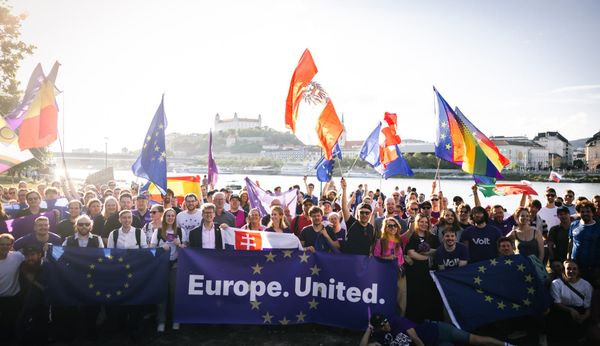
For me, the General Assembly in June 2026 in Bratislava was an amazing experience. It was my first GA after joining Volt earlier this year. The candidates for the new board introduced themselves and I met the new Co-Presidents, Ines and Sven. I discussed the motions with fellow members from my hometown, listened to the speeches on the stage and attended break out sessions. I also marched with the other 500 Volters through Bratislava shouting "Europe - United", but this is another story.
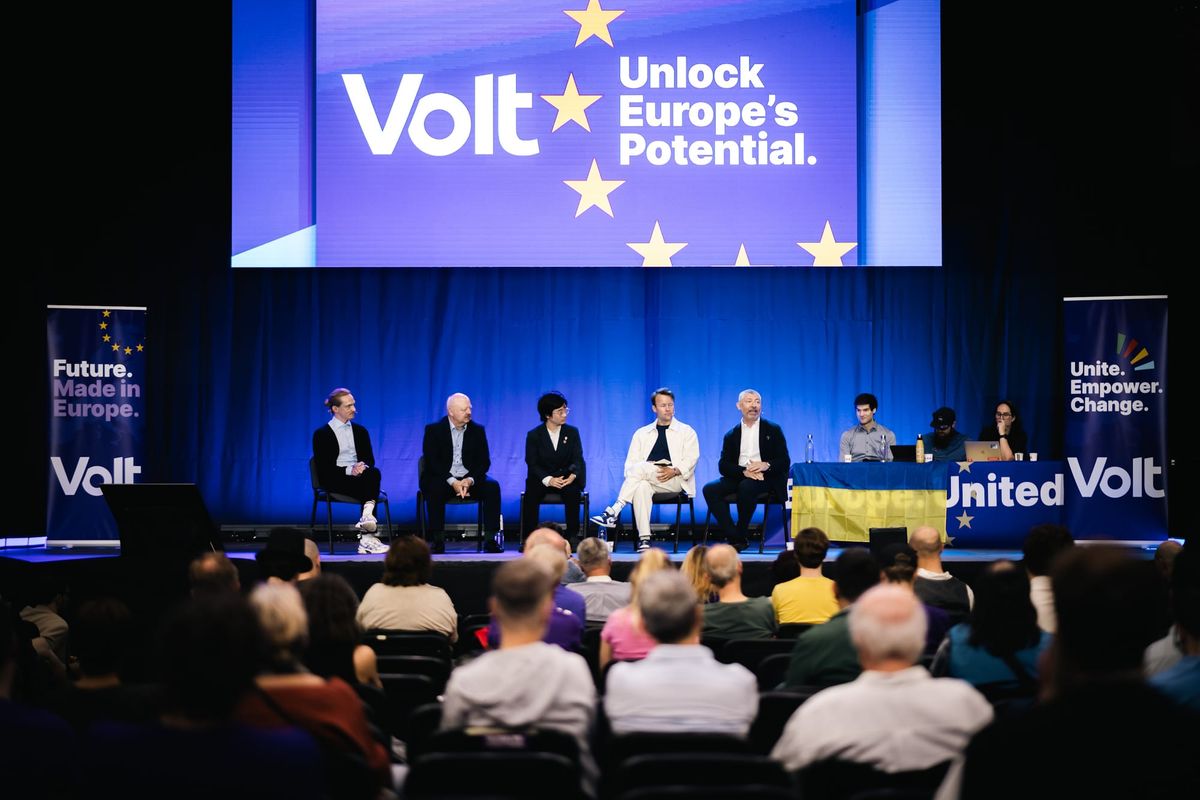
Especially the panel discussion about defence policy impressed me. The speech of Ivan Scalfarotto gave Reinier van Lanschot — and me — goosebumps. He was sitting next to him on stage, while I listened from the audience. Ivan was passionately advocating for united armed forces, similar to the united trade union: "[...] when you negotiate a trade deal and you represent almost 500 million people and you're sitting at the negotiating table, you are strong [...] We have to do this for everything else including defence."
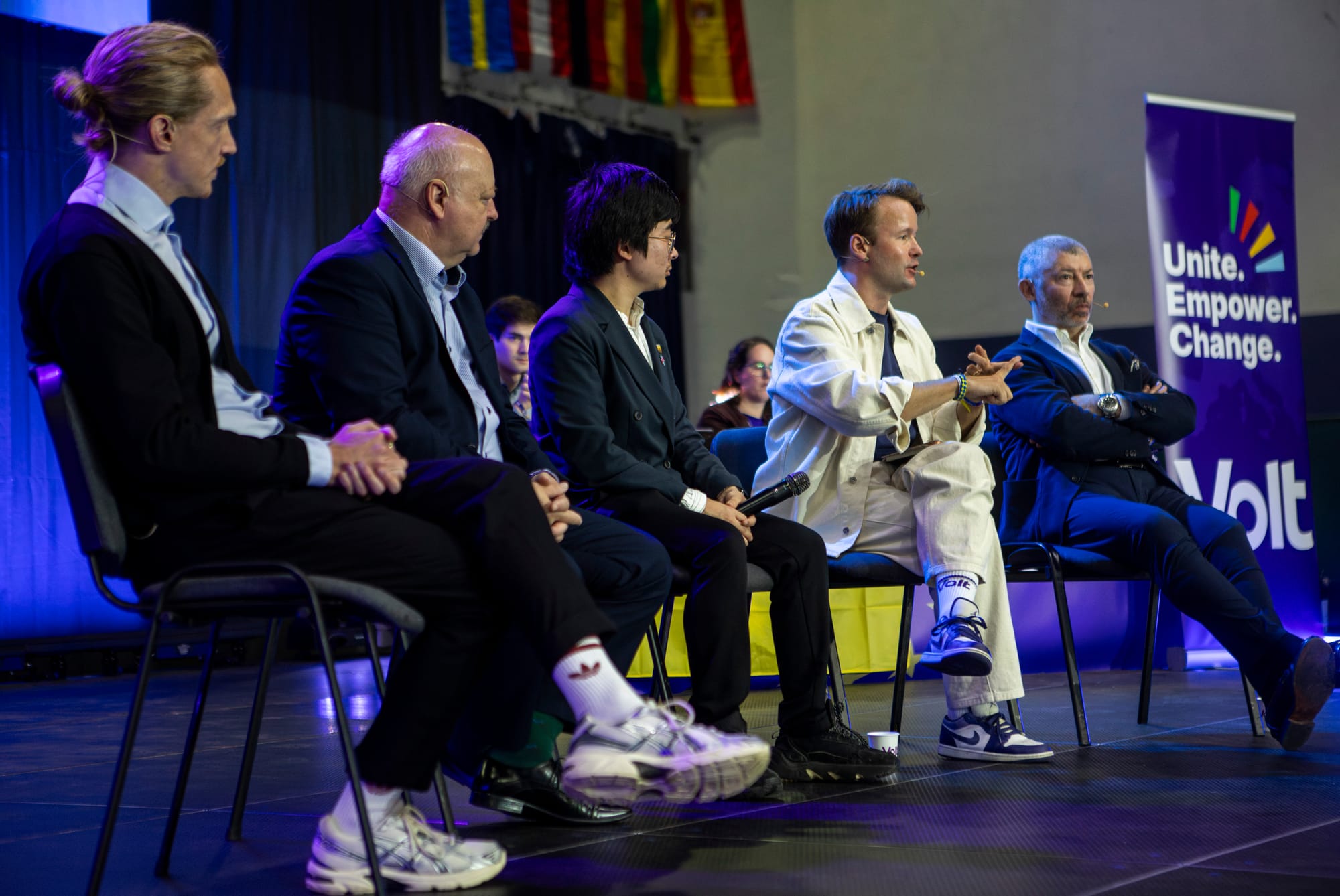
The panel discussion "Why Europe Needs its own Army" [16] was moderated by Jong Chan Lim. General Pavel Macko shared his pragmatic priorities:
-
building command structures across the European armies
-
building shared capabilities that can be used by any European army, like intelligence, air refueling etc.
-
training interoperable units to work together
His core reasoning was that NATO also does not have it's own army, but also collaborates efficiently with existing capabilities. For new strategic technologies he recommends to develop them jointly, like satellite constellations and precision strikes. David Gazsi stressed two points during the discussion:
-
the reluctance of the individual states to give up this core power of their own army
-
the lack of clarity on the goal of a united army
So far I did not see convincing answers to the first concern. The states have their own budget, their own power: in politics, in the army and in the industry. All of them will defend their power, but this is not in the best interest of EU citizens. It will be interesting how Volt will shape their narrative and communication in order to mobilize people to stand up for their interests. On David's second topic of the missing goal, I would think it is becoming obvious, but maybe this is because I am writing this article. My personal top 3 goals are:
-
keep Europeans save and free by deterrence & defence via stationing troops at the borders
-
stabilize Europe and neighboring countries via stationing troops mainly for consultation, training
-
prevent humanitarian catastrophe and genocide by intervention to protect civilians
In terms of competition on a global level there would be more good reasons for me:
-
recruit and train a similar number of military personal as the USA, Russia or China
-
develop weapons, innovative technology and a resilient supply chain
-
build a better public-private cooperation and engage with citizens for civilian commitment
Finally Reinier shared his perspective from the work at European Parliament. From his point of view, the EU needs to compensate for withdrawel of the USA. This not only in number of troops that are stationed across Europe, but also the USA are less reliable for intelligence, logistics and command within NATO: "The military cooperation in NATO is super important, but it’s not enough."
| Speaker | Profile |
|---|---|
David Gazsi  |
Assistant Professor at the Centre for European Integration Research (EIF), Department of Political Science, University of Vienna. He lectured at the Department of War Studies, King’s College London as well as at the Diplomatic Academy of Vienna |
Ivan Scalfarotto  |
Member of the Italian Senate and Foreign Affairs Spokesperson for Italia Viva, the party founded by former Italian Prime Minister Matteo Renzi. A liberal, federalist and lifelong pro-European, he champions civil liberties, free trade and a firm pro-Ukraine stance. He has served as Deputy Minister for Foreign Affairs, Economic Development, Constitutional Reforms and the Interior. |
General Pavel Macko 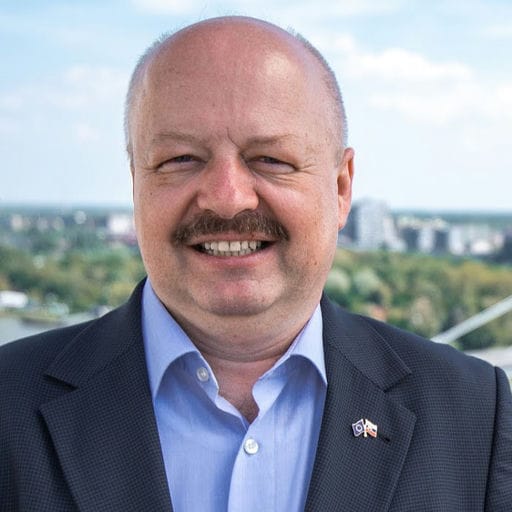 |
3-Star Retired General, he is a defence and security expert with 35 years of military experience.Pavel Macko was a highest-ranking Slovak in the NATO military structures and served as the Commander, NATO Joint Force Training Centre in Bydgoszcz, Poland. |
Reinier van Lanschot  |
Member of the European Parliament for Volt, focusing on Digital Affairs, Defence & Geopolitics. He is member of the Committee on Foreign Affairs and member of the Committee on Security and Defence in the European Parliament. |
How History Informs Europe’s Defence Strategy
Peacekeeping is important as Volt published it in the position paper on the New World Order, but (A) there is war in Europe in Ukraine so can we say Peace-Keeping? and (B) we need to be ready to be involved in the battlefield if this is required to defend freedom in Europe.
“Finally, Europe must help take responsibility for the future world we are building. A just world built on functioning international law and human rights requires a responsibility to protect populations from rogue governments. A future United States of Europe should put a permanent peacekeeping force at the disposal of a reformed United Nations.” [1]
In this section I will look at the past, present and possible future conflicts. War and conflict was always close by. While many nations took some lessons from the wars in the past, there is no guarantee that the EU will not be involved on the battlefield in the future.
Humanitarian Intervention to prevent Genocide
The 1990s Yugoslav Wars proved that disunity kills. 140,000 dead. And the EU stood by. Early military intervention could have prevented or stopped the genocide. It happened on our European continent. 1991–1995 war raged in Slovenia, Croatia and Bosnia. Right at the border of the EU, but member states failed to align and it ended in a humanitarian catastrophe and genocide in Srebrenica with 8.000 Deaths. EU led peace talks failed, only US brokered peace deal in 1995 ended the war. Reading about Srebrenica haunts me. Never again must mean never again.
From 1998–1999 another conflicted escalated in Kosovo's War for independence from Serbia. Ethnic cleansing, mass killings, systematic rape and destruction of Albanian cultural sites could have been prevented. Tensions were there for years since in the 1980s and non-violent resistance failed to achieve independence for Albanians.
Decision making was not possible due to internal misalignment in EU and negotiation power was not given because there was no United Force backing up the negotiations.
General Pavel Macko said at the GA, that the NATO will react and not wait, but the EU can not defend their own interests and values within NATO and UN, if it is backed up by a European Army.
Stabilizing to Preventing Migration Crisis and Terror
The war in Yugoslavia led to a refugee crisis in the 1990s with 1 million Albanian refugees. Later in the 2010s there was civil war in Libia (2014–2020) and Syria (2011-2024) so that the EU was also confronted with a high number of immigrants. It would have been in the interest of EU to provide safety and security at least in parts of the country to prevent that refugees need to knock on the door of the EU.
It also reminds us, that an army is not only build to fight wars but also stabilize regions and manage refugees and migration (like KFOR in Kosovo after the NATO intervention).
Current Conflicts
I am personally a supporter of Ukraine. My colleague is a refugee with her 4 children. Timothy Snyder explains in “On Freedom” [5] all the historic details about the conflict between Ukraine and Russia. He also did not spear the war crimes of Russia and unveils the attempts of Russia to erase Ukraine history and culture.
Will we look back in 10 years and ask why the EU did not interfere and do more? Leading the negotiations, aligning with NATO and UN, stabilizing at least the western part of the Ukraine close to EU borders and providing safety to civilians and by that preventing more refugees. There are already 50.000 civilian deaths, 12 million displaced persons, 280.000 deported children, 40% of Ukrainian critical infrastructure destroyed, 500 billion USD economic damage.
War is a reality right at the border of Poland, Slovakia, Romania. I am from Germany and I am sure that many Germans would be more alerted, if tanks were rolling, drones were flying and people were killed right next to the border of our country.
This war is right next to the border of the EU. In order to manage such conflicts and prevent crisis we need to have a United Army - and of course we need to continue providing humanitarian aid.
A European Army is not enough to defend our Peace Project
This returns me to the core request from Volt:
-
a Europeanised NATO
-
core groups of countries integrating faster and deeper, and
-
a full European Defence Union with a European Army at its center.
This is a bold move, but does that tie together all the threads of our defence debate?
Niinistö [8] points out that public-private partnerships are getting more important. In France private security companies can get a license to ground drones if they get too close to key infrastructure like energy supply and airports [11]. Niinistö also demands emergency plans, supply chain resilience and communication and decision making across borders.
As Volters we are used to think across the member state borders - here we also need to think across the border of civilians, industry and politics. The question is no longer if Europe needs an army, but how we build the foundation across civilians, supply chain, defence industry, member state and EU politics to support our new Army and their soldiers.
Share with our fellow Europeans how we at Volt envision a new security mindset, that includes everyone. This is not a matter of income or education, nor gender identity or LGBTQ+, no matter of religion or where someone was born. All European citizens need to feel prepared for crisis and need to trust and support the new army.
This will turn fear into hope. You can communicate in your discussions and campaigns how Volt will shape a better future for the free people with a new defence union that will be built with the support of all Europeans.
Glossary
| Term | Definition |
|---|---|
| Volt | A pan-European political party advocating for a federal Europe, digital sovereignty, and progressive policies. |
| GA (General Assembly) | Volt’s annual gathering where members debate and vote on policies and leadership. |
| MEPs (Members of the European Parliament) | Elected representatives in the EU’s legislative body. |
| European Defence Union | Volt’s proposed framework for unified EU defence policy, including a European Army. |
| NATO (North Atlantic Treaty Organization) | A military alliance between North American and European countries, currently led by the US. |
| Hybrid Warfare | A mix of conventional and unconventional tactics (e.g., disinformation, cyberattacks, migration weapons) used to destabilize opponents. |
| KFOR (Kosovo Force) | A NATO-led international peacekeeping force in Kosovo. |
| Eurobarometer [7] | The EU’s public opinion survey, measuring citizen attitudes on issues like security and democracy. |
| Niinistö Report [8] | A report (likely by former Finnish President Sauli Niinistö) on EU defence and resilience strategies. |
| EU in a New World Order | Volt’s 2026 position paper outlining its vision for a sovereign, unified Europe in a shifting geopolitical landscape. |
| Dual-Use Technology | Technologies (e.g., drones, AI) with both civilian and military applications. |
| Civilian Resilience | The ability of societies to withstand and recover from crises (e.g., wars, pandemics, disinformation). |
| Interoperability | The ability of different military forces to work together seamlessly (e.g., shared communication systems, joint training). |
| Core Groups (PESCO) | Permanent Structured Cooperation, an EU framework for deeper defence integration among willing member states. |
| Europeanised NATO | Volt’s proposal to strengthen NATO’s European pillar, reducing dependence on the US. |
| Srebrenica | A 1995 genocide in Bosnia where 8,000 Muslim men and boys were killed by Serbian forces—often cited as a failure of EU unity. |
| Yugoslav Wars (1991–1995) | Ethnic conflicts in the Balkans following the breakup of Yugoslavia, marked by war crimes and EU inaction. |
| Kosovo War (1998–1999) | Conflict between Serbia and Kosovo Albanians, ending with NATO intervention to halt ethnic cleansing. |
| Disinformation | Deliberately spread false or misleading information to manipulate public opinion (e.g., Russian or US-backed campaigns). |
| Green Defence | The idea that military innovation can align with climate goals (e.g., clean energy for bases, sustainable materials). |
| Public-Private Partnerships (PPPs) | Collaborations between governments and companies (e.g., defence contracts, cybersecurity initiatives). |
| Hypersonic Missiles | Ultra-fast missiles that evade traditional defence systems, a growing threat in modern warfare. |
| Quantum Computing | A technology that could break current encryption, revolutionizing military logistics and AI. |
| Directed Energy Weapons | Lasers or microwaves used to disable drones, missiles, or other targets. |
| Volt’s Narrative Framework | "Unite, Empower, Change"—Volt’s approach to policy, emphasizing cooperation, hope, and bold reforms. |
References
[1] Volt Europa (2026): The EU in a New World Order (Position Paper).
[2] Reporters Without Borders (2026): Press Freedom Index.
[3] Economist Intelligence Unit (2025): Democracy Index.
[4] Cato Institute (2025): Human Freedom Index.
[5] Timothy Snyder (2021): On Freedom.
[6] Der Spiegel (2025). In Litauen lernen Schüler das Fliegen von Drohnen.
[7] Eurobarometer, EP Spring 2026 survey.
[9] Deutschlandfunk (2026): Lettland: Druck durch Migranten an EU-Außengrenze nimmt zu
[10] Deutschlandfunk (2026): Migration aus Belarus: Flüchtlingszahlen im Baltikum steigen
[11] Deutschlandfunk (2026): Frankreich – Privatfirmen übernehmen zivilen Drohnenschutz
[12] Deutschlandfunk (2026): Härtere Gangart – Rumänien schießt Drohnen ab
[13] Deutschlandfunk (2026): Elon Musk unterstütz Le Pen: Kann das im Wahlkampf zum Problem werden?
[14] Stuttgarter Zeitung (2025): Das hat Porsche künftig mit der Rüstung zu tun
[15] Die Linke (2025). VIII-F-01903 Aktuelle Entwicklungen in der Rüstungsindustrie in Leipzig
[16] Volt (2026): Why Europe Needs its own Army. Panel Discussion at Volt General Assembly in Bratislava