Slovakia for Europe, Volt for Slovakia

Volt boards the UFO: Destination – a stronger Europe
Coming from all across Europe, 500 Volt members converge on Vienna — borderless, bound by purpose. By bus, train, or gliding along the Danube on a catamaran, we follow the river’s timeless current, a living artery stitching together cities, histories, and dreams. Ahead lies Bratislava, where the future of Volt awaits: a weekend where ideas will clash, leaders will rise, and the very soul of a movement will be tested. Yet, as we arrive, we are reminded that this journey is not just about hope — it’s also about resistance. In Slovakia, LGBTQ+ rights have faced growing restrictions in recent years, with the government rolling back protections and promoting exclusionary policies. The fight for equality is as much a part of this story as the flags we carry.
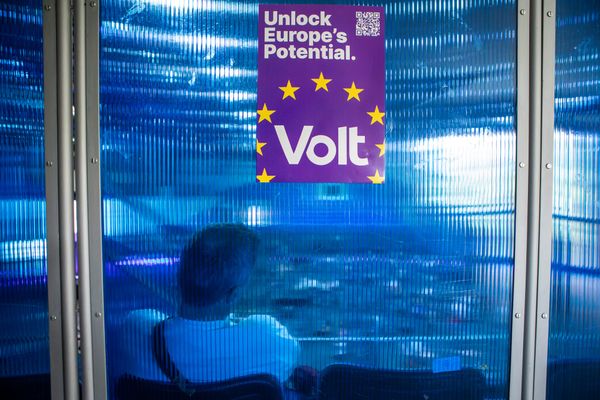
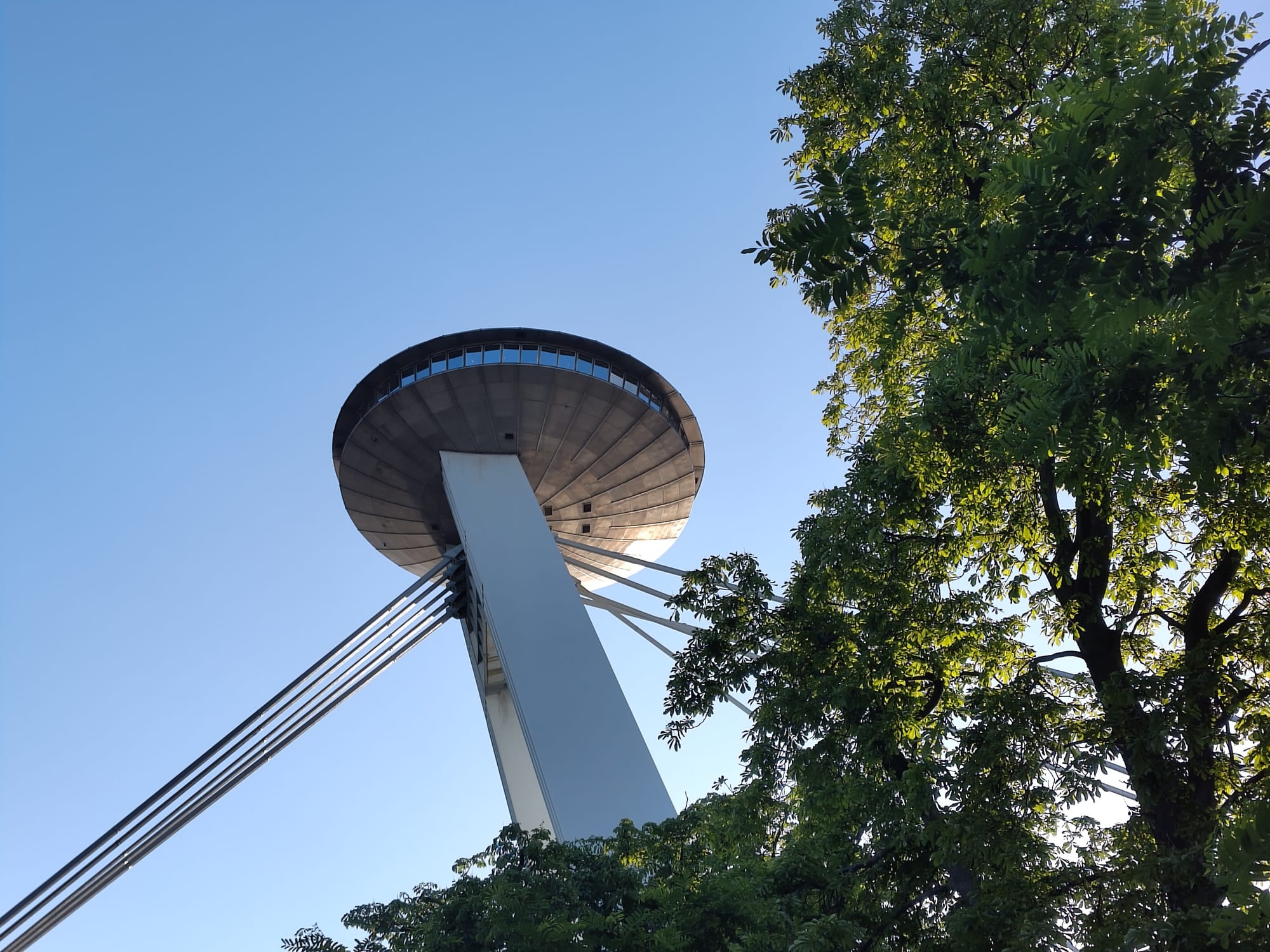
Here, we ascend to the UFO—a structure suspended between earth and sky, just as Slovakia itself has soared from the velvet divorce to the heart of the EU. But stepping inside isn’t just about reaching new heights. It’s about what happens when the doors close behind us: the whispers of doubt, the roar of debate, the moments that will define whether Volt can turn its vision into power.
Over the next chapters, we’ll follow the current of this gathering— from the rapidly shifting weather that set the tone for a weekend of contrasts, to the tense debates over Europe’s future, where the line between idealism and pragmatism blurs. We’ll meet the faces of Volt Slovakia, whose stories of struggle and hope reveal why this small chapter punches above its weight. We’ll stand in the tennis arena turned political stage, where flags from 33 nations fluttered and the air crackled with the weight of decisions that could shape the movement for years to come.
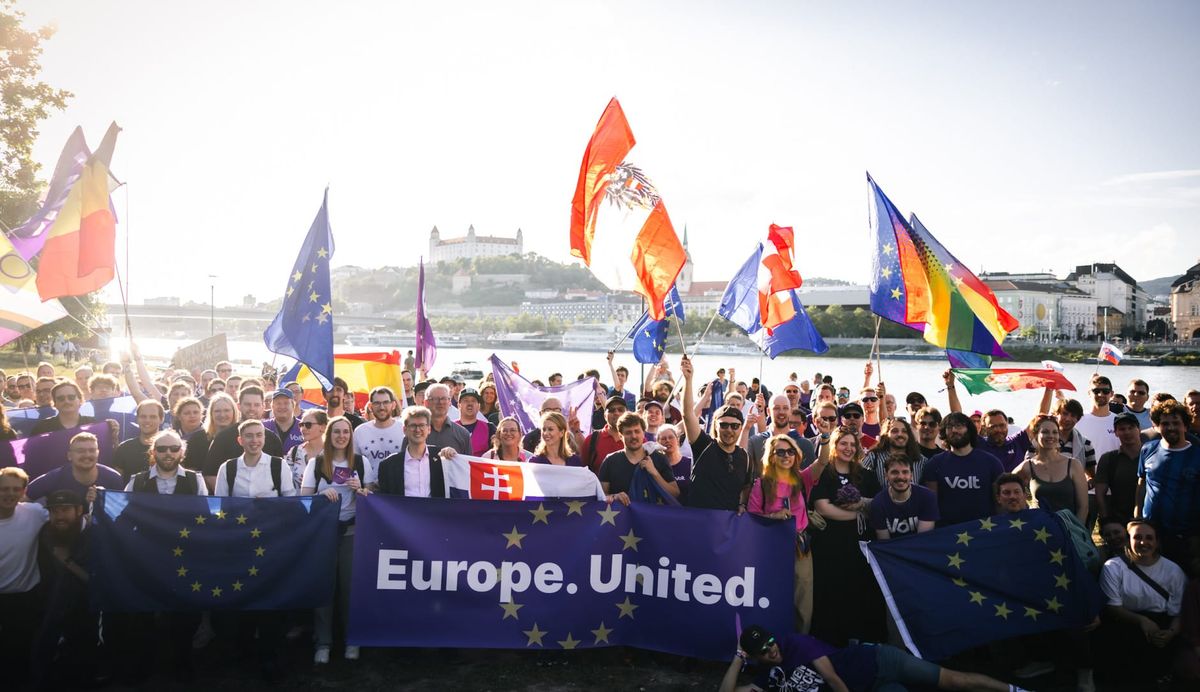
And then, there’s the march—a river of Pride flags, EU banners, and voices crying "Europe—United!"—spilling onto Tyršák Beach, where the Danube’s flow mirrors the current of change Volt is trying to harness. As the sun sets behind Bratislava Castle and the UFO Tower looms above, one question lingers: Can a movement this diverse, this idealistic, this unapologetically European actually pull it off? This is more than a gathering. This is a moment of truth. And the answer begins now.
Slovakia: Volt’s Launchpad to a Stronger Europe
It was mid-June 2026, and the summer sun blazed over Bratislava’s old town as we arrived on Friday. The heat was intense, the kind that made the city’s cobblestone streets feel alive—locals in shorts and sundresses, the air thick with the scent of BBQ and fresh beer. My colleague had already clued me in on the must-try spots: Bratislavský for a taste of authentic Slovak heartiness, Meštiansky Pivovar for a pint of history in a glass. But the real revelation was Luculus—an ice cream so exquisitely delicious that a steady parade of locals and tourists alike streamed past me, licking cones as if the city’s very soul were flavored with vanilla and chocolate.
Yet the journey here hadn’t been all sunshine. The catamaran ride from Vienna had been soaked in rain, the Danube’s waters choppy under a gray sky, as if nature itself were reminding us that not every path to progress is smooth. And as we wandered through Bratislava, the inverted pyramid of Slovenský Rozhlas (Slovak Radio Building) stood as a stark contrast to the baroque charm of the Old Town, its brutalist lines a reminder of the communist era’s bold, if controversial, ambitions. This tension between past and future is also reflected in today’s politics, where progress and regression coexist: a government rolling back LGBTQ+ rights and expressing skepticism of the EU, all while the city’s skyline tells a story of transformation. Bratislava felt like a microcosm of Europe’s tensions: the old and the new, the hopeful and the cautious, the progressive and the regressive, all coexisting in one vibrant, complicated space.
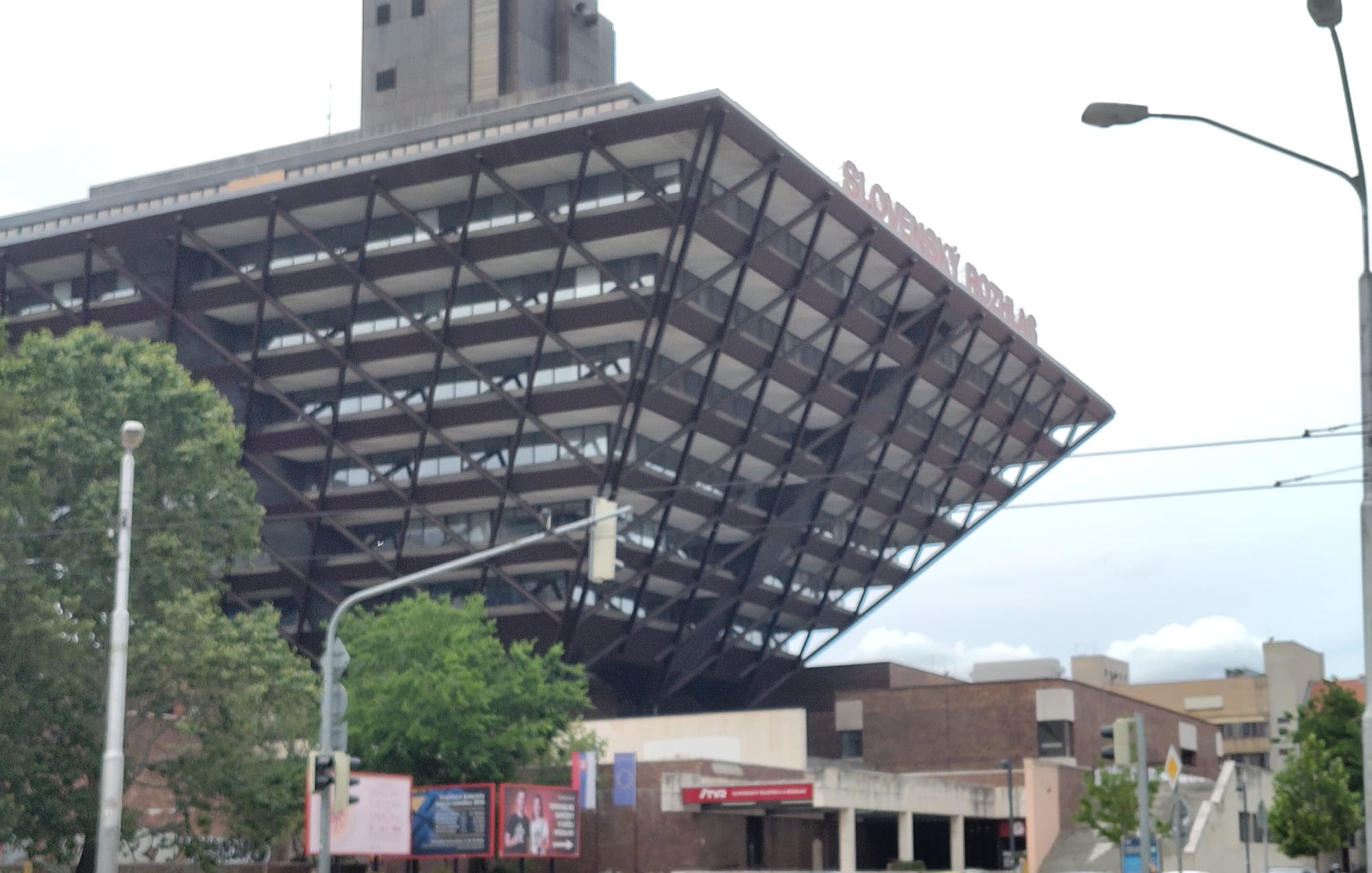
Slovak Radio Building (built in 1983, photo my Michael Eichler)
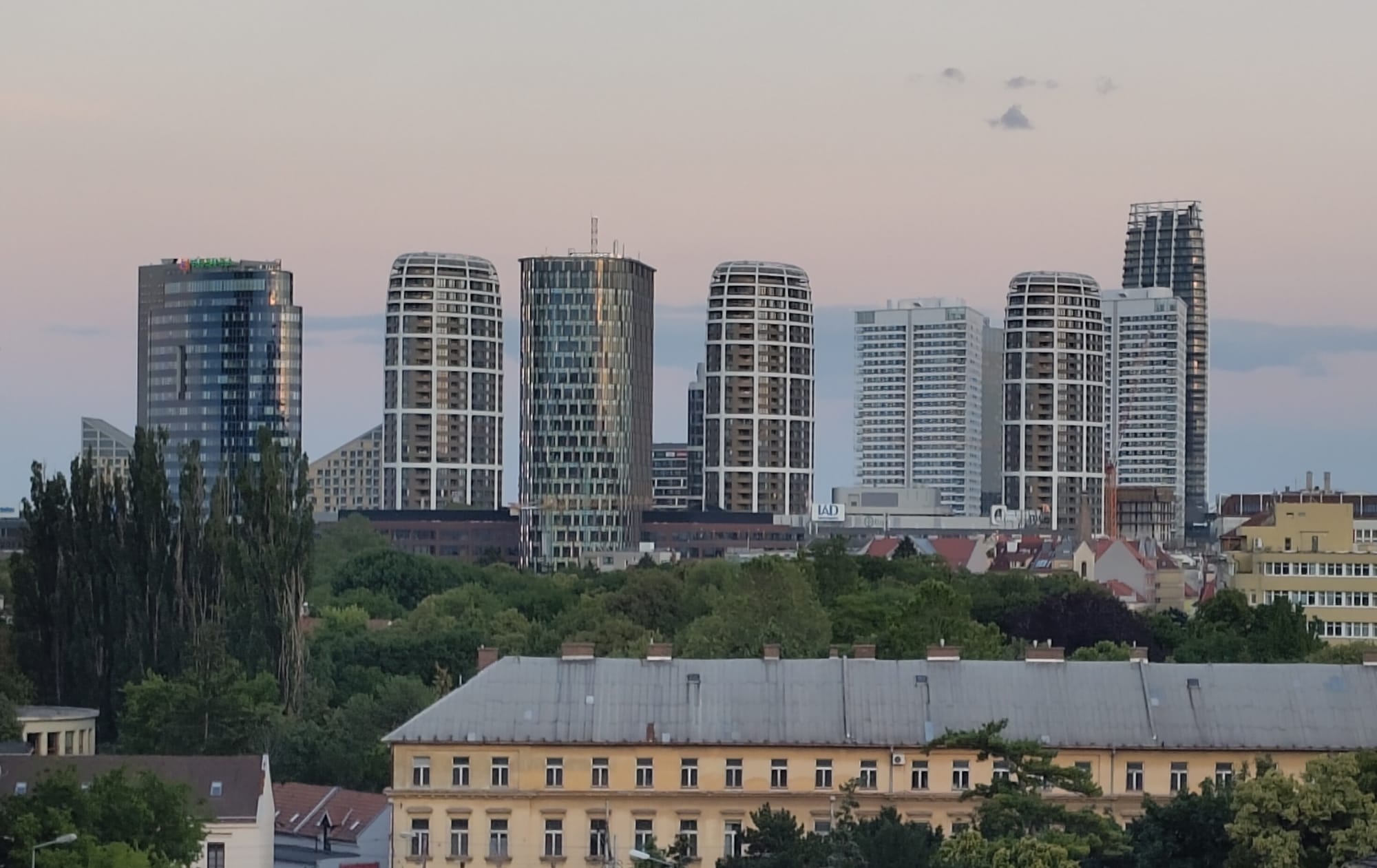
Bratislava Skyline in 2026 (photo my Michael Eichler)
That Friday evening, as the golden light bathed the city, we ascended to the UFO. Suspended above Bratislava, its futuristic silhouette seemed to defy gravity, just like the ambition of our gathering. From this vantage point, the Danube below snaked through the city like a silver thread, connecting not just neighborhoods, but stories—stories of 33 chapters across Europe, all woven together by Volt’s mission.
Stepping inside, we didn’t just observe. We took Volt to new horizons. This wasn’t just a meeting; it was a launchpad. Slovakia wasn’t just a stop on our journey—it was the starting point for something greater. The UFO’s height offered a view of what’s possible when a movement refuses to be overlooked. But the rain on the river, the Soviet concrete below, Fico’s political maneuvers, and the recent attacks on LGBTQ+ rights reminded us: Progress isn’t guaranteed. It’s fought for—through votes, through action, through remembering that democracy and equality are never just given, but choices we make every day.
Slovakia at the Crossroads: Progress, Paradox, and the Fight for Equality
As I wandered through Bratislava’s old town, the first thing that struck me was the price tags. Groceries in the supermarket cost the same as in Berlin, and a meal at a mid-range restaurant could easily rival prices in Luxembourg. This wasn’t the cheap Eastern Europe of old stereotypes—it was a country fully integrated into the European economy. My nephew’s experience drove this home: he spent time in Skalica, working for a German manufacturing company in their industrial engineering plant, a company deeply embedded in Slovakia’s manufacturing sector. If that doesn’t scream European interconnectedness, I don’t know what does. Here, global supply chains and local talent merge seamlessly, proving that Slovakia is no longer on the periphery but at the heart of Europe’s industrial network.
Yet Slovakia’s political story is as complex as its economic one. Robert Fico, the populist leader whose policies have often clashed with EU values, left office in 2019, when Zuzana Čaputová won the presidential elections following mass protests. But in a twist that speaks volumes about the country’s political volatility, he staged a comeback in 2023, riding a wave of discontent with the status quo and capitalizing on fatigue with the establishment. His return to power has reignited debates about Slovakia’s direction: toward Brussels or toward Moscow? Under his leadership, the country has oscillated between EU alignment and flirtations with illiberalism, leaving many Slowaks—and their European partners—wondering which path the nation will ultimately choose.
List of controversal decisions by Slovak government under Fico:
| Title | Description | Month/Year | Link |
|---|---|---|---|
| End of military support for Ukraine | Prime Minister Robert Fico officially announced that his government was stopping military aid to Ukraine and would limit support to humanitarian aid. The announcement was made after a joint meeting at Bratislava Castle with President Peter Pellegrini and Parliament Speaker Richard Raši. | October 26, 2023 | Euronews, BBC |
| Abolition of the Special Prosecutor’s Office | The Slovak parliament approved the abolition of the Special Prosecutor’s Office, which handled serious crimes such as corruption and organized crime. The European Commission initiated infringement proceedings, as the reforms pose a risk to the rule of law. | February 8, 2024 | Euronews, DW |
| Restriction of LGBTQ+ rights | The Slovak parliament passed a constitutional amendment recognizing only two genders (male and female), restricting adoption to married heterosexual couples, and banning surrogacy. The Fico government described this as "enshrining sovereignty in cultural and ethical matters." | September 26, 2025 | BBC, DW |
| Suspension of diesel and electricity supplies to Ukraine | Slovakia suspended diesel fuel deliveries (February 18, 2026) and emergency electricity supplies (February 23, 2026) to Ukraine in response to the dispute over the Druzhba pipeline and Russian oil supplies. | February 18–23, 2026 | DW, DW |
| Criminal law reforms favoring allies | Parliament approved a reform of the criminal code that includes the abolition of the Special Prosecutor’s Office and the National Criminal Agency (NAKA). The changes are intended to hinder investigations against government members and were criticized by the European Commission as a risk to the rule of law. | February 8, 2024 | DW, BBC |
And then there’s the tax question. In 2013 my colleague, a bright entrepreneur, started a tech company after university, full of hope and ambition. But the crushing tax burden—among the highest in the EU—made it impossible to compete. After years of struggling, she shut it down, joined a large software corporation, and later transferred to England. Her story isn’t unique. It’s a brain drain in action, a cautionary tale about how high costs and bureaucracy can stifle innovation and push talent across borders.
The Slovakia that I encountered is a country at the heart of Europe, yes—but one that’s still fighting to define what that means.
Selected membership of Slovakia in international organizations since 2000:
| Organization | Year of Accession | Notes |
|---|---|---|
| OECD | 2000 | Joined as part of its economic reform and integration into global markets. |
| European Union (EU) | 2004 | Joined alongside 9 other countries in the "Big Bang" enlargement. |
| NATO | 2004 | Joined NATO alongside Bulgaria, Estonia, Latvia, Lithuania, Romania, and Slovenia. |
| Schengen Area | 2007 | Abolished border controls with other Schengen states. |
| Eurozone | 2009 | Adopted the euro as its official currency on January 1, 2009. |
Volt Slovakia: Welcoming Europe’s Future
The General Assembly hall buzzed with energy as Rick Zedník stepped to the podium to open the GA. His voice carried the weight of a generation that had watched Slovakia transform from a closed communist state to a nation at the heart of Europe.
He opened his speech by welcoming the crowd to Bratislava—the world’s only capital city bordering two countries—and acknowledging neighboring Volt chapters from Austria, Hungary, Czech Republic, Poland, and Ukraine. He celebrated the 41st anniversary of the Schengen Treaty, noting how natural open borders seem today compared to the past.
He then took the audience on a journey through time, recounting the story of his father, Urai, who went to Norway in 1968 for a student exchange during the Prague Spring. On the morning of August 21st, 1968, Urai woke up to news of the Warsaw Pact invasion of Czechoslovakia. His father chose not to return home for 12 years. Rick contrasted this with the present: Slovaks now commute daily to Austria, some even live in Austria while working in Bratislava, and students study across the EU thanks to programs like Erasmus.
He concluded with Slovakia’s core challenge: "The problem today is not that Slovaks are forbidden from going abroad—it’s that there aren’t enough incentives for them to stay here at home."

Rick Zedník, Co-President of Volt Slovakia (photo by Volt Slovakia)
Lucia Klestincová then took the stage. "So, let’s get present to how brain drain is actually in the DNA of current Slovakia and Volt Slovakia as well," she began. She spoke of the struggle to retain the country’s brightest minds—teachers, nurses, doctors, entrepreneurs — who want to stay but lack the incentives to do so. Her voice softened as she shared a personal moment: her four-year-old daughter, wrapping herself in the European flag as naturally as she breathes. "I don’t want her to grow up preparing for a scenario where brain drain is the only solution," she said. "I want her to have Slovakia as an option."

Lucia Kleštincová, Co-President of Volt Slovakia (photo by Volt Slovakia)
Rick and Lucia concluded their opening speech by inviting potential Volt candidates to the stage, reading out their names and thanked the crowd for their support. Their closing words were a call to embrace visionary thinking: "May you live inspired with the energy and inspiration you will need until the next GA... this is what visionary means, and we will find a way. Thank you so much. Welcome home."
33 Volt Chapters:
The General Assembly: Democracy in Action
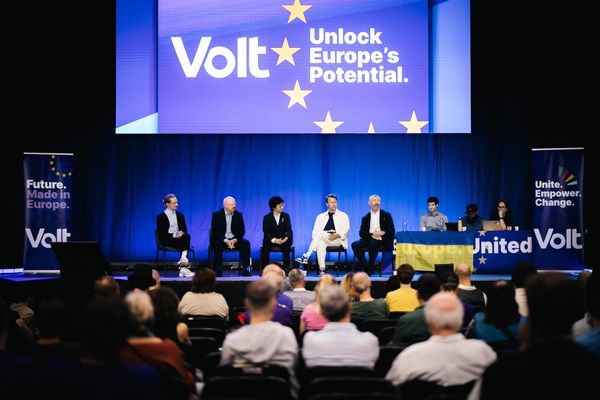
The Peugeot Arena in Bratislava was alive with the hum of democracy. On the main stage, flags from all of Volt’s European chapters hung like a mosaic of the continent itself—each one a reminder that this movement wasn’t just about Slovakia, but about a united, pan-European vision. The flags, vibrant and diverse, seemed to whisper a simple truth: Here, borders didn’t matter. Ideas did.
As I took my seat, the first thing that struck me was the sheer diversity of the crowd. Young and old, locals and visitors, all gathered under the same purple banner. Among the crowd, Reinier van Lanschot (MEP) was a constant presence, contributing to multiple plenum discussions and engaging in lively debates with members at the coffee area. His energy and insights were a reminder of the depth of experience and passion that fuels Volt’s mission.
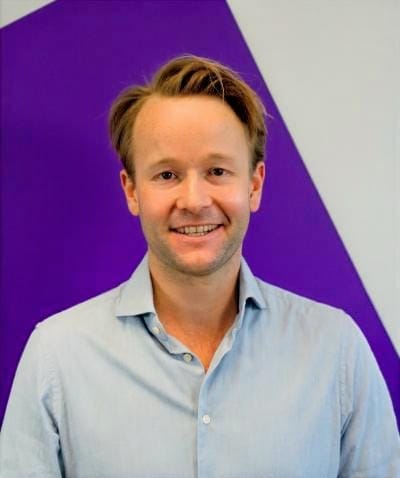
Reinier van Lanschot (photo by Volt Polska)
Reinier van Lanschot is a Dutch politician and Member of the European Parliament (MEP) for Volt Netherlands. He co-founded Volt Netherlands in 2018 and served as its first chairman. A law graduate from the University of Utrecht and Amsterdam, he previously worked in the retail sector before dedicating himself to Volt’s mission. Van Lanschot was the party’s top candidate in the 2019 and 2024 European Parliament elections, securing a seat in 2024. He also served as co-president of Volt Europa (2019–2023), advocating for a more transparent, democratic, and social European Union. In the European Parliament, he is a member of the Committee on Constitutional Affairs and the Committee on Foreign Affairs, among other roles. His political focus includes EU reform, climate action, and humane migration policies.
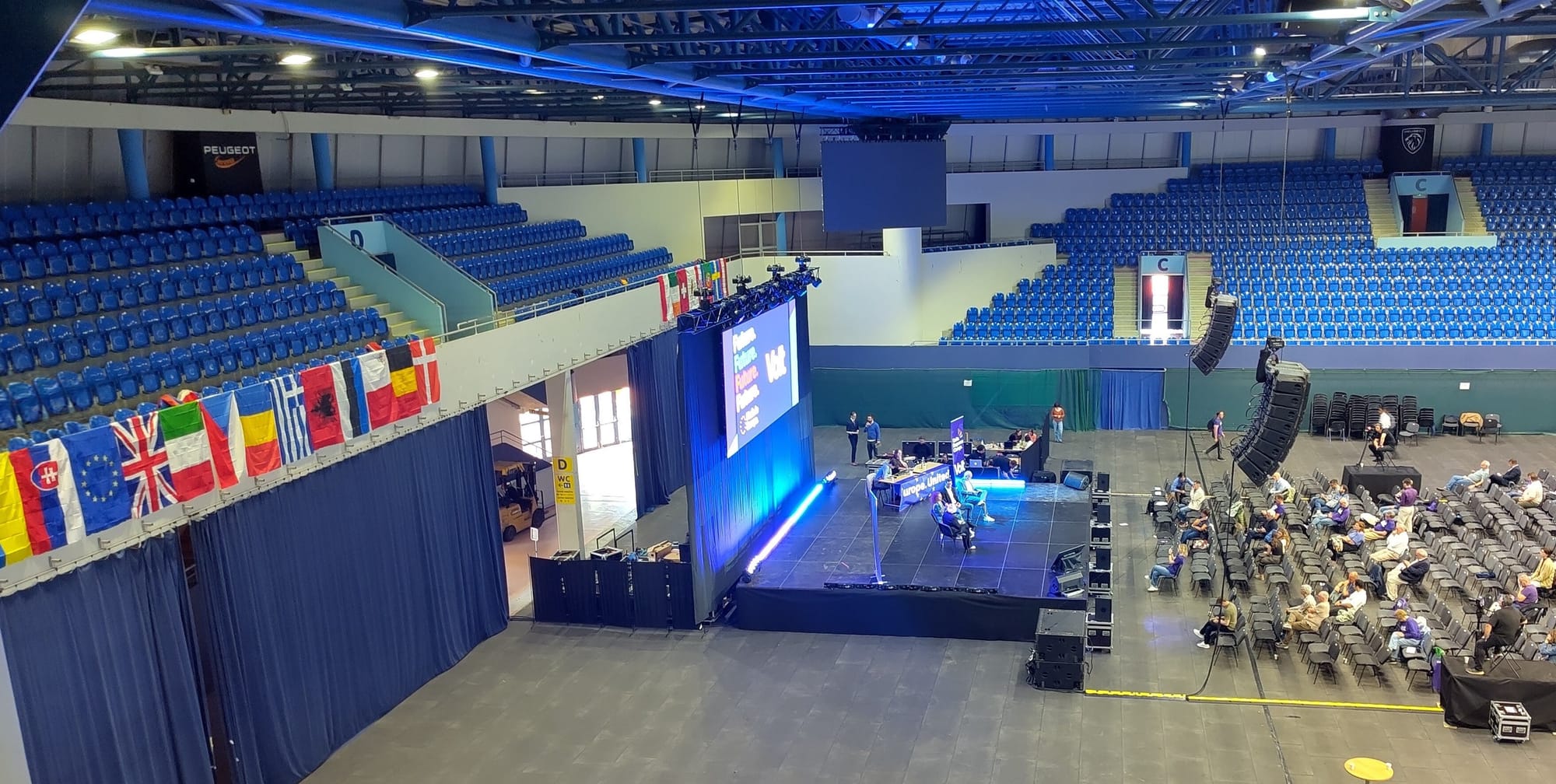
Peugeot Tennis Arena (photo my Michael Eichler)
Between sessions, the coffee area became the heartbeat of the GA. Here, conversations flowed as freely as the espresso, a microcosm of Volt’s pan-European network where ideas were exchanged and the future of the movement was shaped one cup at a time.
I discussed the code of conduct with Reinier van Lanschot, focusing on a critical question: what happens when people misbehave? We explored how to ensure all Volters align with the code, drawing inspiration from large corporations that use mandatory trainings. The Volt Academy could organize these, at least for elected officials, to protect the movement’s reputation and ensure accountability.
The narrative discussion centered on the tension between local identities and a united Europe. Many fear losing their cultural uniqueness in a federal Europe, and the narrative must address this—balancing the celebration of local heritage with the vision of a shared European future.
Another Volter argued that the Compass was too universal, lacking the specificity needed to guide real-world decisions. As one speaker noted on Sunday: "The Compass is a beautiful vision, but without concrete steps, it risks becoming just words on paper." The debate highlighted the need for actionable principles that translate Volt’s ideals into tangible policies.
It was in these informal moments that the true magic of the GA revealed itself. The formal structure of the plenum—with its debates, votes, and resolutions—was important, but it was the unscripted conversations that brought the movement to life. The coffee area wasn’t just a place to refuel; it was a microcosm of Volt’s pan-European network, where ideas were exchanged, friendships were forged, and the future of the movement was shaped one cup at a time.
Back in the main hall, the plenum discussions were a masterclass in how democracy should work. The moderators kept the discussions focused and respectful, ensuring that every voice was heard and every opinion considered. It wasn’t always smooth—there were heated debates about strategy, priorities, and how to grow Volt’s influence in Europe. But even in disagreement, there was a sense of shared mission.
The breakout sessions were where the GA’s energy truly shone. I joined three, each offering a unique window into Volt’s innovative spirit:
-
AI and Voter Targeting: The room was packed as we heard how Volt Munich had used AI to target the right voters and channel their energy with precision. Their data-driven approach, identifying and mobilizing young, urban, and pro-European voters, had directly contributed to their 2026 local election success, where they won 4,7% of votes and 4 seats on Munich’s city council. The message was clear: Technology, when used thoughtfully, could amplify democracy.
-
LGBTQ+ Rights: This session was a celebration of diversity. The room was filled with people of all ages and identities, each sharing their experiences and strategies for advancing LGBTQ+ rights across Europe. From being gay in Italy to transgender refugee experience, the discussion was a powerful reminder of how far we’ve come—and how much further we have to go. It was inspiring to see how Volt was not just talking about inclusion but actively fighting for it, even in the face of rising populism and backlash.
-
Volt Academy: The Volt Academy session on their learning platform was a testament to the movement’s commitment to education and empowerment. The discussion focused on how the platform was being used to train members, share resources, and build a knowledge base for activists across the continent. It was a reminder that Volt wasn’t just a political party—it was a community of learners and leaders. Built on an open-source platform and hosted by Volt IT to ensuring digital souvereignty and data privacy.
As the day wound down, I found myself reflecting on the contrasts and connections I’d witnessed. The flags on the stage symbolized Volt’s pan-European ambition, while the crowded breakout rooms showed its political energy and ambition. The coffee area chats revealed the personal stories behind the politics, and the plenum debates proved that democracy was alive and well in Bratislava.
The Votes: Volt’s Leadership Election
Inês and Sven: Volt’s New Co-Presidents
The election of Volt’s new co-presidents was the centerpiece of the GA. Inês Bravo Figueiredo and Sven Franck, the newly elected leaders, didn’t just deliver speeches—they engaged in a role-play that showcased their ability to think on their feet and embody Volt’s values under pressure. The stage became a living symbol of Volt’s unity: the candidates, rather than highlighting divisions, came together in a circle, demonstrating team spirit and collaboration, making their shared purpose visible and tangible for the audience.
Description of the elected roles:
| Role | Description | Election Rules |
|---|---|---|
| Co-Presidents | Lead Volt Europa’s political direction, represent the movement externally, and drive its pan-European strategy. | Elected by GA members through a democratic voting process. The two Co-Presidents must be of different genders, cannot share the same nationality, and must not have been members of the same Member Association in the two years preceding their election. |
| Treasurer | Oversees financial management, ensures transparency, and balances Volt’s budget with its pan-European ambitions. | Elected by GA members through a standard voting process, with a focus on financial expertise and accountability. |
| Non-Executive Board (6 members) | Provides oversight, ensures accountability, and represents Volt’s diverse chapters across Europe. | Elected by GA members to ensure diverse representation. No more than three Non-Executive Directors can be of the same gender, and the Board may not include more than two members from the same Member Association. |
Inês Bravo Figueiredo, elected as Co-President of Volt Europa at the General Assembly in Bratislava, shares leadership with Sven Franck and is the first Portuguese national to hold this role. Before her election, she served as Co-President of Volt Portugal, where she contributed to the party’s first local council seats in the 2025 municipal elections and was the lead candidate in Portugal’s 2024 legislative elections. She also co-led the Moonshot Programme, Volt’s first pan-European participatory policy platform, which helped elect five MEPs in 2024.
In her pitch before the election, she emphasized Volt’s mission:
"We stand for a federal Europe... because we believe that it’s through us working together that we are going to feel safe in case of war. We want a federal Europe because we know that only through joint economies do we have more prosperous lives. And we want a federal Europe because we believe that only through democracy can we live free lives."
She stressed the need for action:
"I want to make sure that Volt can live up to this potential, that our ideas that are great don’t stay on paper, that they actually get implemented... I want to elect 23 MEPs from seven different countries ahead of the European elections in 2029."
Inês Bravo Figueiredo emphasized that the election signaled change for Volt Europa: "This election also means that there’s change coming to Volt Europa. Choosing me and Sven, we both came with a very clear perspective: let’s make Volt more political. So if you take one thing away from this election today, it’s that we want Volt to be seen more out there, that we’re going to have more impact politically. We’re going to do the things that are going to change people’s lives—starting now."
Inês highlighted her commitment to strategy and tailored messaging: "I want Volt Europa not to fumble in the dark, trying to figure out things again and again. I want to make sure we use the know-how we have internally to design strategies to succeed... We need messages that resonate in each and every country while keeping Volt’s values and identity — presenting the federal Europe we want to build in the best way for each of the different countries." She concluded with pride and ambition: "I’m extremely proud of being part of this movement... I’m extremely grateful for how many hours our volunteers put into Volt Europa... You can count on me to bring you energy, hope, and always ambition because I want us to succeed in 2029, and I know it’s possible. So let’s do it together."
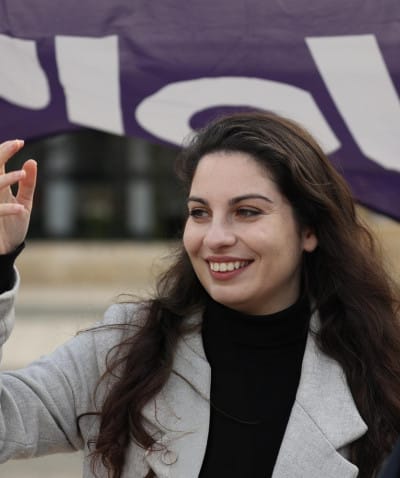
Inês Bravo Figueiredo, Co-President of Volt Europa (photo by Volt Europa)
Sven Franck’s background reflects Volt’s cross-border ethos. Originally from Germany, he has lived in Austria, France, and now Slovenia, where he helped establish Volt as a registered party in 2026. With a career in open-source software and a degree in Business (Innovation Management, Marketing, Finance), he combines technical expertise with political passion. Sven joined Volt in 2018, ran in local elections in 2020, and served as Co-President of Volt France, before leading the party’s 2024 European election campaign.
In his election pitch, Sven outlined a three-pillar vision: influence ("talking to heads of state and civil society leaders"), visibility ("being the reference for the European project"), and storytelling ("making people believe again in Europe"). His goal was clear: "If we manage to get Europe into people’s hearts, we will also arrive on the ballots." He emphasized turning Volt’s ideals into tangible political action, ensuring the movement’s ideas resonate across the continent.
After winning the election as Co-President of Volt Europa, Sven began with gratitude, thanking voters, candidates, and volunteers. He stressed unity and collaboration, noting, "We may have disagreements, but we agree on a lot, and we need to find a way forward together." His priorities included political influence (e.g., speaking at a Warsaw conference), visibility in member states, and media engagement to amplify Volt’s message—even in smaller chapters. "Volt Europa is a mini EU," he said. "We need to prove our vision works by practicing what we preach."
Sven closed with warmth and humor, thanking attendees and joking about Rick’s birthday GA party. His speech blended ambition with pragmatism, reinforcing Volt’s mission: a political, visible, and united force for Europe’s future.
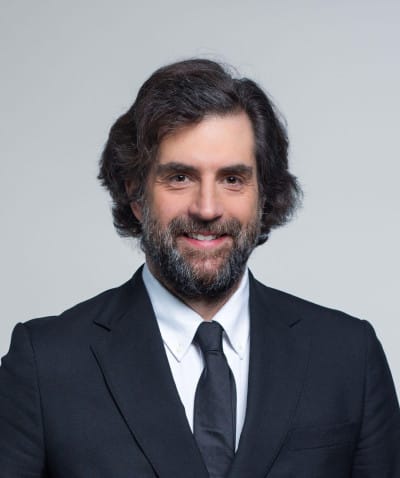
Sven Franck, Co-President of Volt Europa (photo by Volt Europa)
Alberto: Volt’s New Treasurer
Alberto Spatola was elected as Volt’s new treasurer, a role that demands both financial expertise and a deep commitment to transparency. While the co-presidents’ race captured the spotlight, Alberto’s election was a quiet but critical victory for Volt’s future. His focus on stewardship and accountability signaled the movement’s determination to scale responsibly—balancing ambition with the practicalities of funding a pan-European party. In a movement driven by idealism, Alberto’s role is to ensure that vision meets viability.
The New Board Members: Volt’s Strategic Voices
The five non-executive board members elected reflect Volt’s pan-European breadth and grassroots energy. Each brings a unique perspective to the table:
-
Chan Uk Jun (Germany):
With a 30-year career in the global automotive industry and experience as a City Councillor in Kronberg, Chan brings a results-driven, international perspective to Volt. His pitch radiated energy and ambition, emphasizing Europe’s need to stand strong against global threats."Today, Europe is losing ground on what matters. I see an economy that stands up to the threat of America and China. I see a democracy that stands up against the chaos in social media. And I see an army that stands up to any threat."
-
Marieke Koekkoek (Netherlands):
A lifelong activist, former CEO, and Dutch MP for Volt, Marieke speaks seven European languages and embodies Volt’s pan-European spirit. Her pitch was passionate and deeply personal, tying her journey—from motherhood to political activism—to Volt’s mission of unity and resilience."Nine years ago I was pregnant with my oldest son. I thought it was a good time to have a child. Then Brexit happened. Trump round one happened, and I got actively involved... I want to bring that experience of being in the trenches as an active volunteer and as a politician for Volt. I know we can be the strong political force that Europe urgently needs today."
-
Marina Rrika (Albania):
As Co-President of Volt Albania, Marina represents the voices of underrepresented countries and young Europeans striving for opportunity. Her pitch was heartfelt and defiant, rejecting traditional political constraints and advocating for a Volt that empowers the next generation."I love politics, but I refuse to be part of forces who will tell me what to do and how to do it... I’m running to represent all the voices of young people of the countries who are underrepresented and struggling towards the European Union."
-
Mihaela Siritanu (Romania):
A specialist in volunteer management and organizational development, Mihaela focuses on recruiting top talent by offering clear, impactful roles and positioning Volt as a career-launching platform. Her approach is pragmatic and professional, ensuring volunteers feel valued and see their contributions matter."Specialised volunteers leave when their skills are wasted. They stay when their contribution matters... We recruit them with specific problems to solve, defined scope, and tangible outcomes."
-
Slavomír Maňásek (Czechia):
A candidate for re-election, Slavomír is committed to growing Volt’s influence and supporting chapters to become self-sustainable. His pitch was concise and visionary, emphasizing Volt’s potential as a unifying, pan-European force."My vision for Volt in 15 seconds: Volt that keeps growing all across Europe, that is gaining influence to beat the challenges we face... I will keep working for the creation of an EU political foundation. I know the challenges. I know we can do this."
Together, they form a checks-and-balances system—ensuring that Volt’s leadership remains accountable, diverse, and connected to its members across the continent.
The Motions: United States of Europe, EUPP & the Compass – Volt’s Vision in Full Bloom
The process for debating and adopting Volt’s missions was designed to be transparent and inclusive. All proposals were published upfront, giving members ample time to review them. Voting remained open until Monday noon, ensuring everyone had a chance to participate. On Sunday, each motion was presented in detail, allowing members to ask questions, sign up to comment, or voice critiques. This open format ensured that every perspective was heard before the final decisions were made.
| Title | Description | Voting Result |
|---|---|---|
| Policy Infrastructure | Establishes a structured framework for Volt’s policies, ensuring consistency and clarity across all chapters. Includes approval of the Policy Compass and Touchstones as core guiding documents. | Approved |
| Political Narrative | Adopts a unified messaging framework for Volt’s communication, focusing on "Unlock Europe’s Potential. Future. Made in Europe." | Approved |
| Let Us (Re)Focus on Volt | Suspends the informal vote on European Political Party (EUPP) governance principles to refocus Volt’s internal priorities before pushing for external recognition as a pan-European party. | Approved (Suspended Vote #9 as a result) |
| Using the Term "United States of Europe" | Officially adopts the term "United States of Europe" in Volt’s communications as a bold symbolic step toward framing Volt’s vision for a federal Europe. | Approved |
| Mandate the European Board to Explore Legal Pathways for an EUPP | Tasks the board with researching legal avenues to establish Volt as a European Political Party (EUPP), a long-term goal to formalize Volt’s pan-European status. | Approved |
The EUPP (European Political Party) motion was one of the most contentious debates at Volt’s 2026 General Assembly in Bratislava. At its heart was a tension between ambition and pragmatism: Should Volt prioritize becoming a formal EUPP—a long-term goal to solidify its pan-European status—or first focus on internal consolidation, ensuring its rapidly growing chapters (some of which are struggling with scalability) are professionalized and stable?
The pro-EUPP motion, proposed by the Country Council, called for mandating the European Board to explore legal pathways for establishing a mixed EUPP—either as a separate entity or as Volt Europa AISBL itself—while examining the inclusion of non-Volt parties.
However, the counter-motion "Let Us (Re)Focus on Volt", argued for suspension of the informal vote on EUPP governance principles. Its core argument was that Volt must first address its own structural and democratic needs before expanding into a mixed framework with non-Volt entities. The motion stressed procedural and institutional logic. It further warned that skipping this step would bypass democratic sequencing and risk Volt’s transnational identity, institutional sovereignty, and financial stability. The motion demanded a formal, binding vote on the fundamental principle of creating a mixed EUPP, accompanied by a due diligence evaluation of statutory risks and impacts.
The compromise reached reflected the need for balance: While the EUPP exploration was mandated, the informal vote on its governance principles was suspended, ensuring that both professionalization and pan-European ambition would be pursued simultaneously. This dual approach acknowledged that Volt’s growth cannot come at the expense of its stability, and that a movement defined by its pan-European nature must also strive for the structural maturity to sustain it.
The March to the Danube: A Movement United
The sun hung low over Bratislava as we gathered on Mostová Street, the heartbeat of the city’s Old Town. The air was electric—Pride flags, European flags, and the flags of countless nations rippled in the breeze, a living tapestry of Volt’s pan-European spirit. The rainbow colors of the Pride flags stood out vividly, a defiant symbol of love and acceptance in a region where LGBTQ+ rights have faced recent setbacks. Someone grabbed a megaphone, and the call rang out:
"Europe!" The crowd answered as one, a thunderous: "United!" And just like that, we were moving.
The march began along Fajnorovo nábrežie, the Danube embankment alive with the rhythm of footsteps and the rustle of fabric. The Pride colors blazed beside the EU’s circle of stars, a visual manifesto: Here, diversity wasn’t just tolerated—it was celebrated. As we turned onto the Danube River Path, the chants grew louder, the energy infectious. "Europe—United!" echoed over the water, a reminder that this movement was bigger than borders, bigger than any one of us. The flags we carried weren’t just symbols; they were a declaration that every person, regardless of who they love or how they identify, has a place in this Europe we’re building.
We snaked through Gondova Street, past historic buildings that had seen empires rise and fall, now bearing witness to something new: a generation marching for a Europe that could be. And then, the Starý Most (Old Bridge)—our flags caught the wind as we crossed, the Danube below a silent partner in our journey. For a moment, it felt like the river itself was carrying us forward.
As the march reached Tyršák Beach, the formalities of the GA melted away. The flags that had led us here were now planted in the sand, fluttering beside the Danube as Volters from across Europe spread out in small groups. The scene was a microcosm of Volt itself: a kaleidoscope of cultures, languages, and perspectives, all united by a shared belief in a stronger, more colorful Europe.
We met with other Volters from our countries and regions — something we don’t often get the chance to do. In our bubble, we debated candidates, elections, and missions, sharing perspectives and experiences. Meanwhile, on stage, music was played by Volters from different countries, adding to the lively atmosphere of the gathering.
It struck me then: this was Europe in its purest form. Not the Europe of borders or bureaucracies, but the Europe of people—diverse, determined, and united in their differences.
As the sun began to dip below the horizon, I looked up at the Bratislava Castle and the UFO Tower—one a symbol of Slovakia’s past, the other of its future. From this vantage point, the progress of the GA felt tangible. We had elected new leaders, debated bold missions, and reaffirmed our shared purpose. But more than that, we had lived the values we so often spoke about: unity, diversity, and the belief that Europe’s strength lies in its people.
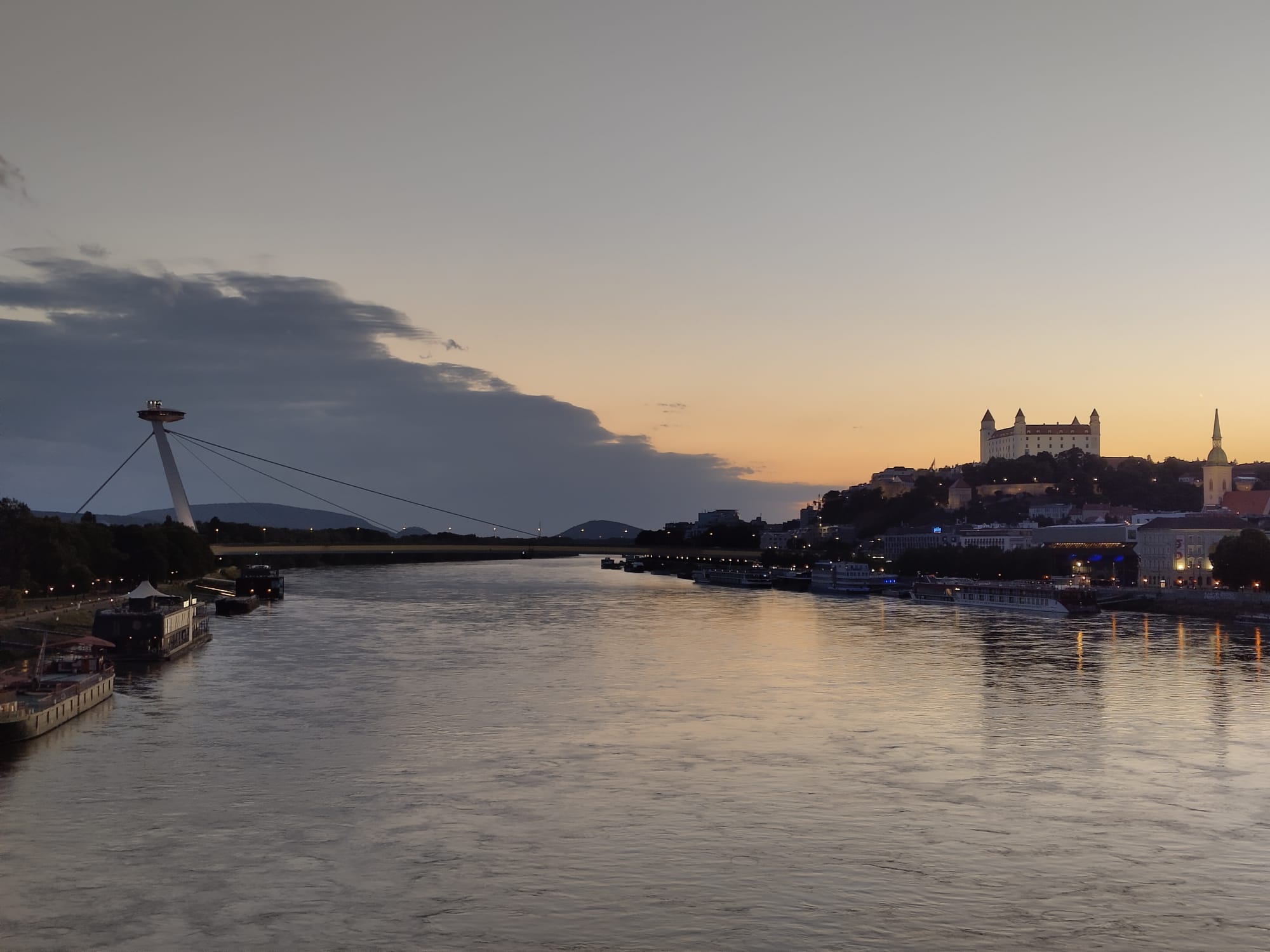
Bratislava in June 2026 (photo my Michael Eichler)
The Danube, flowing steadily beside us, felt like a metaphor for Volt itself: diverse currents, one river. As we prepared to leave Bratislava, I couldn’t help but think: This was more than a march. This was a promise. A promise to keep fighting for a Europe that is open, inclusive, and unafraid of its own diversity—a Europe where everyone, no matter who they are or who they love, has a place.
The discussions about Volt’s future—its candidates, elections, and motions — were a reminder of what we’re ultimately fighting for: a Europe of Free People. A Europe where you can wake up in Bratislava, debate the future of democracy with friends, and then drive just an hour to hike through the breathtaking gorges of Suchá Belá and Prielom Hornádu in the Slovak Paradise National Park, or explore the otherworldly ice formations of the Dobšiná Ice Cave. A Europe where borders are not barriers, but bridges—between ideas, between people, and between the natural wonders that bind us together.

Slovak Paradise National Park (photo by Fabian Walenczak)
So I ask you: What part are you playing? Have you already found your place in Volt and in Europe? The road ahead is long, and the work is hard, but the reward—a Europe that is truly united, truly equal, truly for all — is worth every step. This was only the beginning of the story we would write together.
References
Volt
Volt Europa Bratislava Declaration